


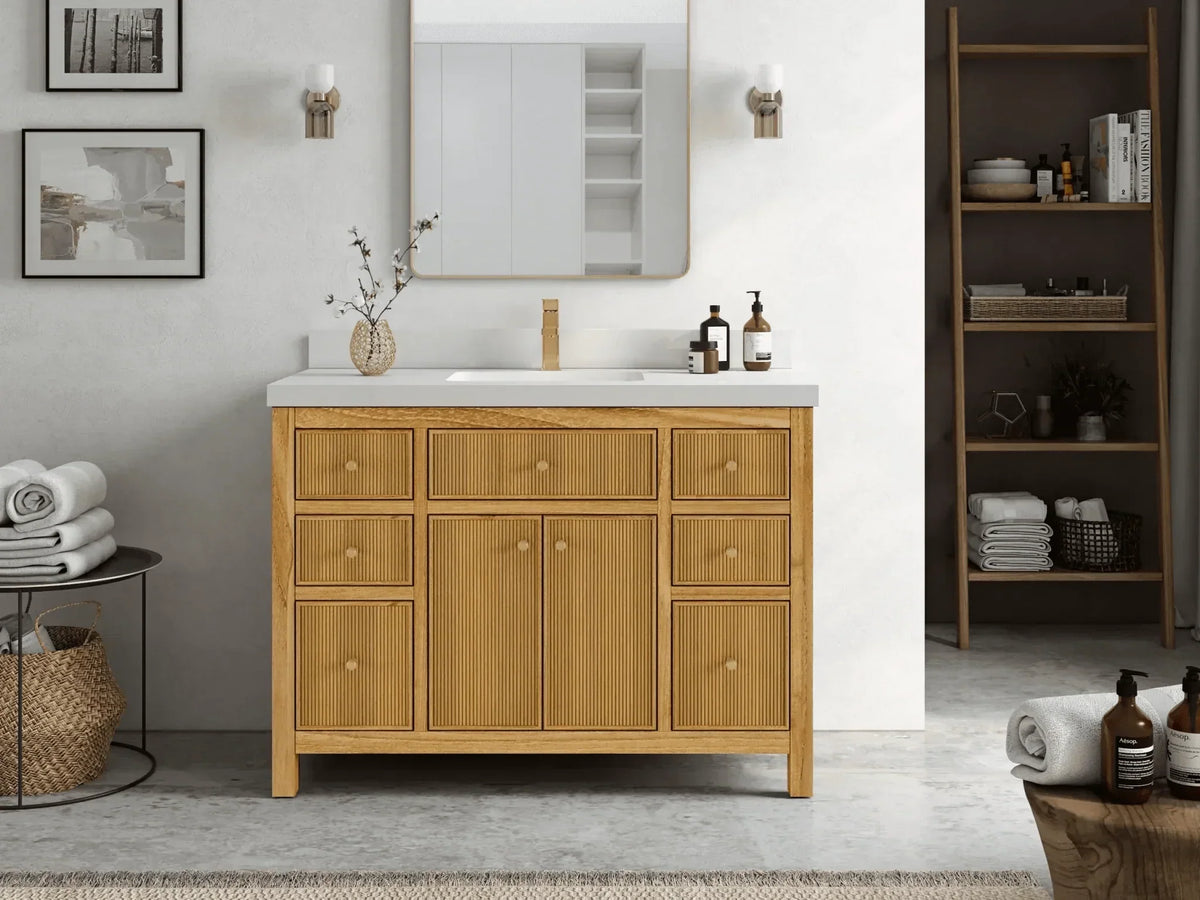
Most people discover their vanity is particle board the day it starts swelling. That moment always arrives two years after the warranty expires and six months after you stop keeping the receipt.
Here is the uncomfortable truth: bathroom showrooms never volunteer: the word "wood" on a price tag means almost nothing without reading the fine print. Engineered boards, MDF cores, and timber veneers all qualify technically.
None of them behaves like real wood when a bathroom starts doing what bathrooms do every single day. A genuine, solid wood bathroom vanity costs more upfront. Over twenty to forty years of daily use, it is almost always the cheapest decision you ever made in that room.
What Actually Qualifies as a Solid Wood Bathroom Vanity
This is where a lot of homeowners get caught up during renovations. Walk through any bathroom showroom, and you will see the word "wood" displayed everywhere confidently. Most of it is not what you think it is.
Engineered boards with a timber veneer bonded on top look convincing from across the room. After a few years of real bathroom use, a completely different picture emerges at the corners, around the hinges, and near the sink.
A real solid wood bathroom vanity is made from natural timber all the way through, not just the surface layer you can see. Oak, maple, walnut, and birch. These materials existed for centuries before anyone started manufacturing bathroom furniture from them.
When shopping, look for FSC-certified wood from responsibly managed forests. FSC-certified vanities ensure environmental sustainability and higher quality standards.
Bathrooms are genuinely punishing environments. Steam, condensation, temperature swings, and daily splashing create humidity above 60%, which causes wood to expand 0.2-0.4%. Proper sealants reduce moisture absorption by 85-90%.
Cheaper engineered materials take all of that personally and show it over time. Properly sealed solid timber simply does not react the same way.
The Longevity Argument Is Impossible to Ignore
According to the National Kitchen and Bath Association, MDF and particle board vanities typically require replacement within six to ten years under normal bathroom conditions. A well-built, solid wood bathroom vanity, properly maintained, routinely lasts twenty to forty years. That is not marketing language. That is the material doing what timber has always done.
Got a surface scratch on solid wood? Sand it lightly and refinish. With MDF, a scratch is essentially a countdown to full replacement because moisture enters the exposed core, and the swelling begins immediately.
Hardware stays tight in solid timber across years of real use too. Screws grip natural wood grain firmly over time. In softer engineered boards, they gradually work loose, and one morning, your drawer handle simply comes away in your hand without warning.
Many pressed wood products also release low-level formaldehyde from adhesive compounds over time. In an enclosed bathroom space used twice daily, that is worth taking seriously. A solid wood bathroom vanity carries none of that concern.
|
Vanity Type |
Average Lifespan |
Estimated Replacements Over 30 Years |
|
MDF/Particle Board |
6-10 Years |
3-4 |
|
Solid Wood |
20-40 Years |
0-1 |
Getting the Size Right Matters More Than People Realise
A lot of renovation regret comes down to sizing decisions made too quickly under showroom pressure. Too large, and the bathroom feels permanently cramped. Too small, and you are fighting for counter space every single morning.
For most powder rooms, guest bathrooms, and tighter en-suites, a 30 inch bathroom vanity hits the sweet spot consistently. It provides genuine usable storage and a proper countertop surface without visually dominating a smaller room or creating awkward traffic flow.
A 30 inch bathroom vanity is the dimension professional designers reach for first in compact spaces because it works with the room rather than against it. Everything around it: door swings, floor space, and mirror placement stay proportional.
If you want the installation to go smoothly without compatibility headaches, choose a 30 inch bathroom vanity with a sink included. The basin, countertop, and cabinet come pre-matched and sized to work together, removing the measurement stress that catches most homeowners off guard mid-renovation.
Why White Oak Deserves Its Moment
If you have spent any time researching bathroom vanities recently, you have come across the white oak vanity repeatedly. It keeps appearing in every serious renovation conversation for a reason.
White oak has a clean grain, understated and not competing with surrounding tiles, mirrors, or wall colours. It has a real warmth to it without being loud or in your face in the room.
Pair a white oak vanity with matte black hardware, and it reads modern. Change to brushed brass, and it goes to something warmer and more classic. There are few materials as versatile.
White oak also handles real family bathroom traffic well. It does not turn every small scuff or knock into a visible problem, which matters far more than most people admit upfront.
The Long-Term Benefits Nobody Mentions
Here’s why a solid wood bathroom vanity is truly a wise long-term choice and not just an attractive one worth paying more for.
Your taste will change. Trends shift, you repaint walls, and suddenly everything needs to feel different. A white oak vanity or any solid timber piece can be restained, repainted, or refitted with new hardware without the underlying structure suffering at all.
Buyers notice quality during property inspections, too. A solid wood bathroom vanity that still looks and performs well after years of use tells a story about how the entire home has been maintained and cared for.
Over a fifteen to twenty-year period, solid wood is often the more economical choice because you’re not replacing it every eight years like clockwork.

It's Not Difficult to Take Care of a Solid Wood Bathroom Vanity (5-Step Routine)
A solid wood bathroom vanity demands little in return for decades of service, but following a clear routine helps. Here's what our customers do:
1. Clean weekly: Use mild soap + soft cloth (no abrasive products)
2. Reseal every 3-5 years: Apply water-resistant varnish to protect the finish
3. Run exhaust fan 20-30 minutes after every shower: This prevents 85% of moisture damage
4. Avoid harsh chemicals: no bleach, ammonia, or abrasive cleaners
5. Inspect annually: Check for cracks, finish wear, and hinge tightness
Following just these 5 steps keeps your solid wood vanity looking new for 20-40 years.
Frequently Asked Questions
Can a solid wood bathroom vanity handle a humid bathroom?
Yes. When properly sealed and paired with an exhaust fan, a solid wood bathroom vanity handles normal bathroom humidity without warping, swelling, or showing surface deterioration over time.
What is the difference between solid wood and veneer?
A solid wood bathroom vanity uses real natural timber throughout its entire structure. Veneer is a thin wood layer bonded over an engineered board. Both look similar initially, but behave very differently under sustained moisture exposure.
Why is the white oak vanity so popular right now?
A white oak vanity is durable, visually versatile, and works with almost any hardware finish or bathroom aesthetic. It is one of the rare materials that performs well practically while also looking genuinely considered and intentional.
Is a 30 inch bathroom vanity large enough for everyday use?
For most smaller bathrooms, guest bathrooms, and powder rooms, yes. A 30 inch bathroom vanity balances usable storage and countertop space without overwhelming the available floor area around it.
Should I get a 30 inch bathroom vanity with sink included?
For most renovation projects, absolutely. A 30 inch bathroom vanity with a sink included simplifies installation and eliminates compatibility or sizing issues between the basin and cabinet that catch people off guard.
How long does a solid wood bathroom vanity actually last?
With basic maintenance, a well-built, solid wood bathroom vanity can last twenty to forty years or longer. That is not an exaggeration. That is simply what quality timber does when it is looked after properly.
Share:
What It Costs to Upgrade to a 60 Inch Double Sink Vanity Top
Avoid These Cleaning Mistakes for Your Solid Wood Bathroom Vanity