



Are floating vanities a good idea? Yes, when the wall can support the installed load, the plumbing can be coordinated with the cabinet, and the open-floor look suits the room. They make cleaning easier, allow a planned counter height, and create a lighter architectural appearance. Their drawbacks are a more demanding installation, less floor-to-counter storage in some models, and possible plumbing or wall-framing work.
This guide covers the general benefits, drawbacks, structural requirements, plumbing, mounting height, and installation sequence so you can decide whether a wall-mounted vanity is right for the project.
For live products and current availability, shop floating bathroom vanities. Keep this guide for the structural and installation decision.
Floating Vanity Pros and Cons
| Benefits | Drawbacks |
|---|---|
| Visible floor gives the cabinet a lighter appearance | Wall support and fastener planning are critical |
| Floor is easier to sweep and mop | Drywall anchors alone are not suitable for a heavy vanity |
| Finished counter height can be planned for the users | Changing height can require plumbing, mirror, and outlet coordination |
| Continuous flooring creates a clean architectural line | Existing floor-fed plumbing may be difficult to conceal |
| Drawers and cabinets can still provide concealed storage | Some models hold less than a full-height floor-standing cabinet |
| Works across modern, minimalist, and warm natural-wood interiors | Installation may take more preparation and professional labor |
When a Floating Vanity Is a Good Choice
A floating vanity is a strong option when:
- the wall has studs or can receive structural blocking at the mounting points;
- you are remodeling with the wall open and can coordinate framing and rough plumbing;
- continuous flooring and easy cleaning are important;
- you want to set the finished counter at a planned height;
- the design calls for a light, wall-mounted cabinet rather than a floor-standing furniture piece; and
- the selected cabinet still provides enough storage for the household.
It can work in a powder room, guest bath, or large primary bathroom. The suitability comes from the structure, plumbing, layout, and storage plan—not from room size alone.
When a Freestanding Vanity May Be Better
Consider a freestanding vanity when:
- the wall cannot be opened or reinforced and the existing framing does not align with the mounting system;
- floor-fed drain or supply lines cannot be rerouted or concealed appropriately;
- maximum cabinet volume from floor to counter is the main priority;
- the installation needs to be simpler and less dependent on hidden wall conditions; or
- the design calls for legs, a toe-kick, or a traditional furniture profile.
Neither mounting style is universally better. Compare the complete room and installation requirements in the bathroom vanity buying guide.
Wall Structure and Blocking
The wall carries the cabinet, countertop, sink, stored items, and forces created during daily use. The mounting system therefore needs to fasten into appropriate structural framing or solid blocking according to the manufacturer's instructions.
Studs
Locate the studs and compare them with the vanity's mounting rail, cleat, or fastening points. Stud spacing does not always align with every cabinet, especially when plumbing occupies the same wall area.
Horizontal blocking
When the wall is open, solid horizontal blocking between studs can create reliable fastening positions across the vanity width. Decide the finished counter height, cabinet location, and mounting-system position before the blocking is installed.
Wall condition
Check that the finished wall is flat and plumb. A bowed or uneven surface can keep the cabinet from sitting flush, affect door alignment, and complicate the backsplash installation.
Structural caution: never rely on drywall anchors alone to carry a solid-wood floating vanity and stone top. Follow the exact product instructions and have uncertain framing evaluated before mounting.
Plumbing Considerations
A wall-mounted cabinet exposes the floor below, so plumbing that rises from the floor can remain visible or conflict with the open area. Wall-fed drain and supply lines often create the cleanest result, but their rough-in positions must align with the sink and internal drawer layout.
Before closing the wall:
- choose the exact vanity, sink, countertop, and faucet;
- set the intended finished counter height;
- mark the cabinet mounting system and structural blocking;
- overlay the drain and supply locations on the cabinet drawing;
- make sure plumbing does not pass through a drawer bank or mounting rail; and
- coordinate service access for shutoff valves and the drain trap.
Dry-fit the cabinet before making irreversible field cuts. Any cut edges should be protected as directed, and a licensed plumber should complete or approve the final connections.
Mounting Height
A floating vanity is not attached to the floor, so the counter height can be planned within the product and project constraints. Decide height from the finished countertop surface, not from the bottom of the cabinet.
Coordinate the chosen height with:
- the primary users and any accessibility goals;
- sink type and rim height;
- faucet and backsplash;
- mirror and medicine-cabinet position;
- wall outlets and lighting;
- drain and supply rough-ins; and
- the amount of visible floor desired below the cabinet.
A custom height is only helpful when the entire wall elevation is planned together.
Storage and Daily Use
Floating does not mean storage-free. Many models use deep drawers, internal organizers, and cabinets around the plumbing. Compare usable interior volume, not only the exterior number of doors and drawers.
Check whether the household needs:
- shallow drawers for grooming tools and toiletries;
- deeper compartments for tall bottles or towels;
- separate zones for two users;
- accessible space around plumbing connections;
- appliance storage coordinated with bathroom electrical requirements; and
- additional mirror, linen, or wall storage.
Explore floating single-sink vanities and compare the specification drawings and internal layouts before choosing a cabinet.
Materials and Finish
A wall-mounted vanity should be evaluated as both cabinetry and a supported load. Review the cabinet-core materials, joinery, mounting system, top weight, sink configuration, and care instructions for the exact model.
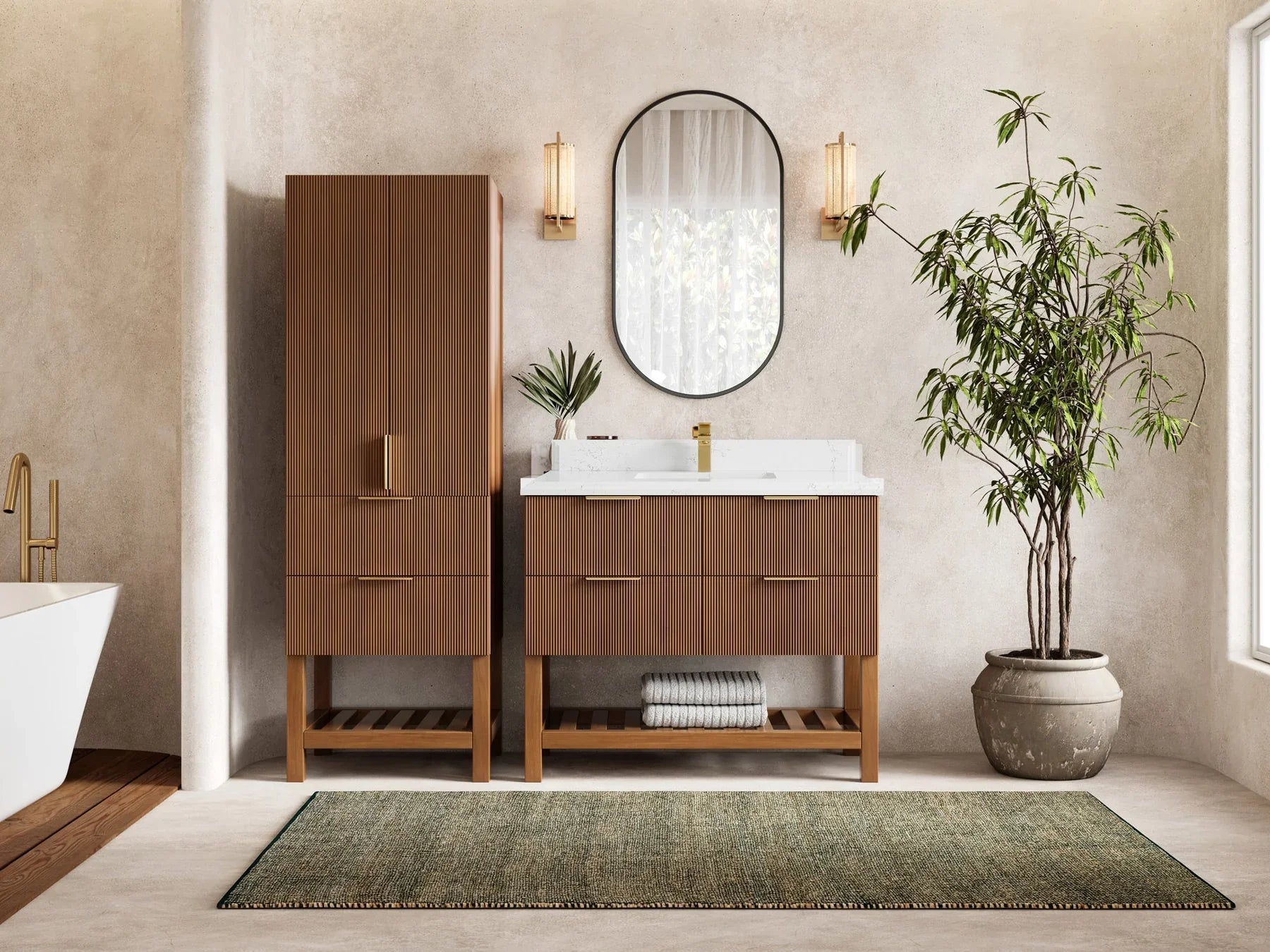
Light white oak can emphasize the airy appearance, while warm teak makes the cabinet feel more like furniture. Painted finishes can coordinate with built-ins or wall color. The Houston collection is one place to compare solid-wood floating configurations and finishes.
Installation Sequence
| Stage | Main check | Why it matters |
|---|---|---|
| 1. Product selection | Exact cabinet, top, sink, faucet, and mounting instructions | The rough-in cannot be planned accurately from nominal width alone |
| 2. Wall preparation | Studs, blocking, flatness, and finished wall surface | The wall carries the installed load and keeps the cabinet aligned |
| 3. Rough plumbing and electrical | Lines and outlets clear drawers, hardware, and the mounting system | Prevents conflicts after the wall and cabinet are finished |
| 4. Cabinet mounting | Correct fasteners, level, wall contact, and required supports | Protects structural performance and door alignment |
| 5. Top, sink, and faucet | Handling, support, sealing, and curing sequence | Stone and fixtures add load and must be installed in the proper order |
| 6. Final inspection | Leaks, level, fasteners, drawers, doors, and wall joints | Catches installation problems before regular use |
Use qualified trades where required and follow the instructions supplied with every component. Cabinet, stone, plumbing, and electrical work may have different installation responsibilities.
So, Are Floating Vanities Worth It?
A floating vanity is worth considering when its open-floor appearance, easier cleaning, and planned mounting height add value to daily use—and when the wall and plumbing can be prepared correctly. It is a poor shortcut for a wall that cannot support the load or a layout that depends on floor-fed plumbing remaining hidden.
Choose it for the complete system: cabinet, structure, top, sink, plumbing, storage, and installation. If your project is specifically a compact room, use the separate floating vanity guide for small bathrooms for width, clearance, and storage planning.
Frequently Asked Questions
Are floating vanities a good idea?
They are a good idea when the wall can support the installed load, plumbing can be coordinated with the cabinet, and the household values visible floor, easier cleaning, and a planned counter height.
What are the disadvantages of a floating vanity?
The main drawbacks are more demanding structural and plumbing preparation, possible loss of some floor-to-counter storage, and installation that depends on hidden wall conditions and correct fastening.
Can a floating vanity be mounted on drywall?
The finished wall can be drywall, but the vanity should not rely on drywall anchors alone. Its mounting system needs to fasten into suitable studs or structural blocking according to the product instructions.
Can existing plumbing work with a floating vanity?
Sometimes. Wall-fed plumbing often coordinates most cleanly with the open-floor design. Existing floor-fed lines may need rerouting or a deliberate concealment plan, and all lines must clear the drawers and mounting hardware.
How high should a floating vanity be mounted?
Choose the finished countertop height based on the users, sink, faucet, mirror, outlets, lighting, plumbing, and any accessibility goals. Set blocking and rough-ins only after that full elevation is planned.
Do floating vanities hold a stone countertop?
They can when the cabinet and mounting system are designed for the application and are properly fastened to adequate structure. The support plan must account for the cabinet, stone, sink, stored items, and daily use.
Evaluate the complete installation. Confirm wall structure, plumbing, height, storage, top weight, and mounting instructions before choosing a floating vanity.
Shop floating vanities · compare the Houston collection · read the buying guide.
Share:
Bathroom Vanity Lighting Guide: Fixtures, Placement & Bulbs
Willow Quartz Countertop Color Gallery: Swatches & Pairings