


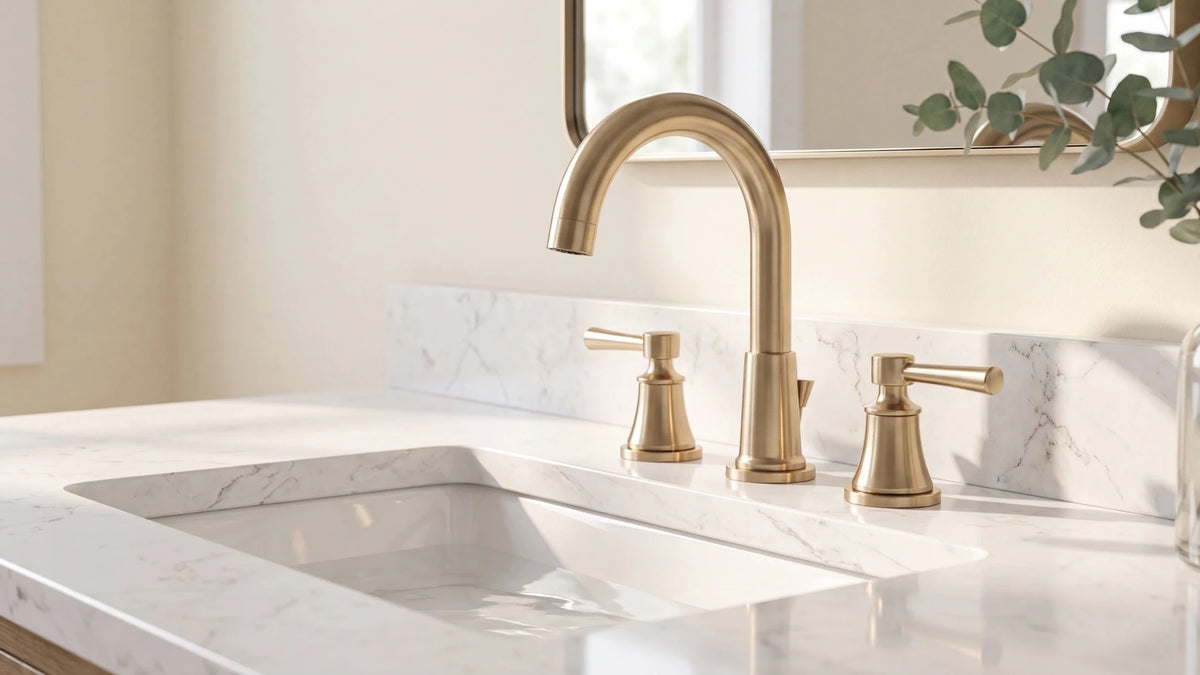
Choosing a bathroom faucet sounds simple until you see the options: single-hole, 4-inch centerset, 8-inch widespread, wall-mounted, vessel sink faucets, deck-mount faucets, high-arc faucets, low-profile faucets, brushed brass, matte black, chrome, brushed nickel, and more.
The easiest way to choose the right bathroom faucet is to start with fit first, style second. Before choosing a finish or handle shape, check your sink or vanity top: how many faucet holes does it have, how far apart are the holes, and what type of sink are you using?
A faucet that looks beautiful online can still be wrong for your vanity if the hole spacing, spout reach, sink depth, or wall clearance does not match. This guide explains the most common bathroom faucet types and helps you decide which one is best for your bathroom, powder room, guest bath, primary bathroom, or double vanity. When ordering a Willow vanity with a countertop, choose Wall-mount (no countertop faucet holes), Single-hole, 4-inch spread, or 8-inch spread. Drilling charges are applied per sink and shown below.
The fastest way to choose the right bathroom faucet
Choose your faucet based on your sink or countertop holes:
| Faucet type | Hole setup | Best for | Style feel |
|---|---|---|---|
| Single-hole faucet | 1 hole | Modern vanities, small sinks, clean design | Minimal, modern, easy to clean |
| 4-inch centerset faucet | 3 holes, 4-inch spread | Guest baths, rental bathrooms, compact vanities | Classic, practical, budget-friendly |
| 8-inch widespread faucet | 3 holes, 8 to 16-inch spread | Primary bathrooms, larger vanities, luxury looks | Custom, elegant, designer |
| Wall-mount faucet | Mounted in the wall | Custom remodels, vessel sinks, clean countertops | Spa-like, high-end, architectural |
| Vessel sink faucet | Tall deck-mount or wall-mount | Above-counter vessel sinks | Statement, boutique, powder-room style |
The key measurement is faucet spread: the distance from the center of the left hole to the center of the right hole. A 4-inch spread usually means a centerset faucet. An 8-inch or wider spread usually means a widespread faucet.

Willow faucet drilling options and pricing
Choose the drilling pattern when ordering your vanity. Faucet hardware is not included.
| Faucet drilling | Single sink | Double sink |
|---|---|---|
| Wall-mount | Included | Included |
| Single-hole | +$15 | +$30 |
| 4-inch spread | +$45 | +$90 |
| 8-inch spread | +$45 | +$90 |
1. Single-hole bathroom faucet
A single-hole bathroom faucet is one of the most popular choices for modern bathrooms. It usually has one spout and one handle in a compact body. It fits a sink or vanity top with one faucet hole.
Single-hole faucets are ideal for people who want a clean, simple look. They are also great for small bathroom vanities because they do not take up much countertop space. A single-handle design makes it easy to control water temperature and flow with one hand. Many single-hole faucets can also be installed on a three-hole vanity top if they include an escutcheon plate or deck plate that covers the unused holes.
Choose a single-hole faucet if you like a minimalist bathroom style, modern vanity design, easy countertop cleaning, or a compact faucet for a small sink. Single-hole faucets work especially well with floating vanities, modern oak vanities, integrated sink vanities, and clean white quartz or porcelain vanity tops.

2. 4-inch centerset bathroom faucet
A 4-inch centerset faucet is designed for a three-hole sink or vanity top where the outside holes are 4 inches apart. This is one of the most common setups in older bathrooms, guest bathrooms, rental properties, and compact vanity tops.
A centerset faucet usually has the spout and handles connected on one base plate. It can have two handles or one handle, depending on the design. Because everything is built into one unit, centerset faucets are often easier to install and replace than widespread faucets.
Choose a 4-inch centerset faucet if you are replacing an existing faucet on a vanity top with three holes that measure 4 inches apart. This is a smart choice for budget-friendly remodels, guest bathrooms, kids' bathrooms, rental units, and small vanities where space matters. Centerset faucets often feel more traditional, transitional, or practical.

3. 8-inch widespread bathroom faucet
An 8-inch widespread faucet is a three-piece faucet: one spout and two separate handles. The pieces are installed individually, usually with 8 inches between the hot and cold handles. Many widespread faucets can fit wider spreads too, often up to 16 inches depending on the model.
This is the faucet style people often choose when they want the bathroom to look more expensive. Because the spout and handles are separate, a widespread faucet gives the vanity top a more custom, spacious, designer look.
Choose an 8-inch widespread faucet if you have a larger vanity, a primary bathroom, a double sink vanity, a luxury bathroom remodel, or a countertop already drilled for 8-inch widespread installation. Widespread faucets look especially good on marble tops, quartz tops, thick vanity countertops, traditional vanities, transitional vanities, and high-end furniture-style bathroom vanities.

4. Mini-widespread faucet
A mini-widespread faucet gives you the look of a widespread faucet but in a smaller footprint. It is usually used when someone wants separate handles and a more custom look, but the sink or vanity top has tighter spacing.
Choose a mini-widespread faucet if you like the separate-handle look of a widespread faucet, but you are working with a smaller bathroom vanity or a tighter countertop layout.
5. Wall-mount bathroom faucet
A wall-mount bathroom faucet is installed into the wall above the sink instead of into the countertop. This creates a clean, open counter surface and a very high-end look.
Wall-mounted faucets are popular in modern bathrooms, spa bathrooms, powder rooms, and custom vanity designs. They also pair beautifully with vessel sinks, floating vanities, stone sinks, concrete sinks, and integrated sink vanities.
The important thing: a wall-mounted faucet is usually best for a new remodel or custom construction. It often requires plumbing inside the wall, careful rough-in placement, and precise alignment between the spout, drain, and sink bowl.
Choose a wall-mount faucet if you are doing a full bathroom remodel, building a custom vanity, choosing a vessel sink, or designing a spa-like bathroom. Wall-mount faucets are also excellent if you want easier countertop cleaning because there is no faucet base sitting on the vanity top. Watch out for spout reach and height: if the faucet is too high or the sink is too shallow, water can splash; if the spout does not reach far enough into the basin, water may hit too close to the back of the sink.

6. Vessel sink faucet
A vessel sink faucet is made for an above-counter sink. Since vessel sinks sit on top of the countertop, they usually need either a tall deck-mount faucet or a wall-mounted faucet.
This is a popular choice for powder rooms because it creates a boutique hotel look. Vessel sinks can feel dramatic and stylish, especially when paired with a slim faucet, wall-mounted faucet, brushed brass faucet, matte black faucet, or natural stone sink.
Choose a vessel sink faucet if your sink sits above the counter. Measure the sink height first. The faucet must be tall enough to clear the rim and long enough for the water stream to land comfortably inside the bowl, ideally near the drain area.

7. Deck-mount vs wall-mount faucet
A deck-mount faucet is installed directly into the sink, vanity top, or countertop. Single-hole, centerset, and widespread faucets are usually deck-mount faucets. A wall-mount faucet is installed into the wall behind the sink.
For most replacement projects, deck-mount is easier. For custom remodels, wall-mount can look cleaner and more expensive. Choose deck-mount if you are replacing an existing faucet, using a standard vanity top, or want easier installation. Choose wall-mount if you are designing the whole bathroom from scratch, opening the wall anyway, or want a sleek spa-style vanity.
8. Single-handle vs two-handle bathroom faucet
A single-handle faucet controls hot and cold water with one handle. It is easy to use, simple to clean, and common in modern bathrooms. A two-handle faucet has separate hot and cold handles. It gives a more traditional, balanced look and allows more precise control for some users.
Choose single-handle if you want convenience, modern style, fewer parts to clean, and easy everyday use. Choose two-handle if you like classic design, cross handles, widespread faucets, traditional vanities, or a more symmetrical look.
9. How to choose the best faucet finish
The finish changes the whole personality of the bathroom. The most common bathroom faucet finishes are chrome, brushed nickel, matte black, brushed brass, polished nickel, oil-rubbed bronze, and gold.
Chrome bathroom faucet
Chrome is bright, clean, classic, and usually one of the easiest finishes to match. It works with modern, traditional, and budget-friendly bathrooms.
Brushed nickel bathroom faucet
Brushed nickel has a softer, warmer silver tone. It is a good choice for busy bathrooms because it usually hides fingerprints and water spots better than very shiny finishes.
Matte black bathroom faucet
Matte black creates contrast. It looks modern, bold, and graphic, especially with white sinks, white quartz tops, oak vanities, reeded vanities, fluted vanities, and minimalist bathrooms.
Brushed brass or gold bathroom faucet
Brushed brass and gold finishes add warmth and luxury. They pair beautifully with natural wood vanities, white marble, cream stone, fluted cabinet fronts, reeded oak, and furniture-style bathroom vanities.
Oil-rubbed bronze bathroom faucet
Oil-rubbed bronze works best in traditional, rustic, Tuscan, vintage, or farmhouse bathrooms.
10. What type of faucet do people choose most often?
Most shoppers choose based on three things: what fits the vanity top, what matches the bathroom style, and how easy it is to live with every day.
People remodeling a small bathroom often choose single-hole or 4-inch centerset faucets because they are compact and practical. People designing a primary bathroom often choose 8-inch widespread faucets because they look more elegant and high-end. People designing a powder room often choose wall-mounted or vessel sink faucets because the powder room is a place where homeowners feel comfortable making a stronger design statement. People who want the easiest cleaning usually prefer single-hole or wall-mount faucets because there are fewer pieces sitting on the countertop. People who like traditional bathroom design usually choose two-handle centerset or two-handle widespread faucets. People who like modern bathroom design usually choose single-hole, matte black, brushed brass, or wall-mounted faucets.
11. Best faucet choice by bathroom type
- Small bathroom: single-hole faucet or 4-inch centerset faucet — compact, easy to install, space-saving.
- Guest bathroom: 4-inch centerset or single-hole with deck plate — practical, budget-friendly, easy to replace.
- Primary bathroom: 8-inch widespread faucet — more elegant, balanced, and luxurious.
- Double sink vanity: two matching 8-inch widespread faucets or two single-hole faucets, depending on the vanity top drilling — creates symmetry and a designer look.
- Powder room: wall-mount faucet, vessel sink faucet, or brushed brass single-hole faucet — powder rooms are perfect for statement design.
- Kids' bathroom: single-handle faucet or low-profile centerset faucet — easy to use and practical for daily routines.
- Luxury bathroom remodel: widespread faucet or wall-mounted faucet — both look more custom and high-end.
12. Faucet measurements you must check before buying
- Number of faucet holes — one hole, three holes, or a wall-mount rough-in?
- Faucet hole spacing — is it 4-inch centerset or 8-inch widespread?
- Spout reach — will the water land comfortably inside the sink?
- Spout height — is there enough room to wash hands without splashing?
- Sink depth — shallow sinks need careful faucet height and flow control.
- Backsplash clearance — make sure the faucet handle can move without hitting the wall or backsplash.
- Drain compatibility — some faucets include a drain assembly, some do not.
- Flow rate — look for WaterSense-labeled bathroom faucets if water savings matter.
13. Common bathroom faucet mistakes
- Choosing the finish before checking the hole spacing. A beautiful 8-inch widespread faucet will not fit a 4-inch centerset vanity top. Always measure first.
- Buying a vessel faucet for a regular undermount sink. Vessel faucets are taller. On a standard undermount or drop-in sink, they can look oversized and may splash.
- Forgetting the deck plate. A single-hole faucet can sometimes cover unused holes with a deck plate, but not every model includes one. Check before buying.
- Choosing a wall-mount faucet too late. Wall-mounted faucets require planning before the wall and countertop are finished. They are not usually a simple last-minute swap.
- Ignoring spout reach. The faucet should direct water into the sink bowl comfortably. If the spout is too short, water lands too close to the back; if it is too long, it may feel awkward.
- Mixing finishes randomly. You can mix metals, but it should look intentional — for example, brushed brass faucet with brass cabinet pulls, or matte black faucet with a black mirror frame and shower trim.
14. So, which bathroom faucet should you choose?
Choose a single-hole bathroom faucet if you want a modern, clean, easy-to-maintain look. Choose a 4-inch centerset faucet if your existing vanity top has three holes with a 4-inch spread and you want an easy replacement. Choose an 8-inch widespread faucet if you want a more custom, elegant, high-end look for a larger bathroom vanity. Choose a wall-mount bathroom faucet if you are doing a custom remodel and want a clean, spa-like, designer bathroom. Choose a vessel sink faucet if your sink sits above the countertop.
The best bathroom faucet is the one that fits your vanity top, works with your sink, matches your design style, and feels comfortable every day. Browse solid-wood vanities with pre-drilled tops in the full collection, or compare the single-sink and double-sink ranges from Willow Bath and Vanity and select your faucet configuration at checkout.
FAQ
What is the best type of bathroom faucet?
The best bathroom faucet depends on your sink and vanity top. For small modern bathrooms, a single-hole faucet is usually best. For a 4-inch three-hole vanity top, choose a centerset faucet. For a larger primary bathroom, an 8-inch widespread faucet usually looks more elegant. For custom remodels, wall-mount faucets create a high-end spa look.
What is the difference between a 4-inch and 8-inch bathroom faucet?
A 4-inch bathroom faucet usually means a centerset faucet where the hot and cold handles are 4 inches apart. An 8-inch bathroom faucet usually means a widespread faucet where the spout and handles are separate pieces installed across a wider spread.
What is a single-hole bathroom faucet?
A single-hole bathroom faucet installs through one hole in the sink or countertop. It usually has one handle and one spout in a compact body. It is popular for modern vanities, small bathrooms, and minimalist bathroom designs.
Can I put a single-hole faucet on a three-hole sink?
Yes, many single-hole faucets can be installed on a three-hole sink if they come with an escutcheon plate or deck plate to cover the extra holes. Always check the faucet specifications before buying.
Can an 8-inch widespread faucet fit a 4-inch centerset sink?
Usually no. A widespread faucet is made for wider hole spacing, typically around 8 inches or more. A 4-inch centerset sink needs a centerset faucet, a mini-widespread faucet made for 4-inch spacing, or a single-hole faucet with a deck plate.
Are widespread faucets better than centerset faucets?
Widespread faucets usually look more custom and luxurious, while centerset faucets are more compact, practical, and budget-friendly. Widespread is often better for primary bathrooms and larger vanities. Centerset is often better for small bathrooms, guest baths, and simple replacements.
Are wall-mounted bathroom faucets worth it?
Wall-mounted bathroom faucets are worth it if you want a clean, high-end look and are doing a custom remodel. They free up counter space and make the vanity top easier to clean. However, they require more planning and may need plumbing inside the wall.
What faucet should I use with a vessel sink?
A vessel sink usually needs a tall vessel faucet or a wall-mounted faucet. The spout should clear the rim of the vessel sink and reach far enough so the water lands comfortably inside the bowl.
What bathroom faucet finish is easiest to maintain?
Brushed nickel and brushed finishes usually hide fingerprints and water spots better than very shiny finishes. Chrome is classic and easy to match, while matte black and brushed brass are popular for more decorative bathroom designs.
Should bathroom faucets match cabinet hardware?
They can match, but they do not have to. Matching the faucet and cabinet hardware creates a coordinated look. Mixing metals can also look designer if it is intentional, such as brushed brass hardware with a matte black mirror or a chrome faucet with polished nickel lighting.
What faucet is best for a double sink vanity?
For a double sink vanity, choose two matching faucets. If the vanity top has 8-inch widespread drilling, use two widespread faucets. If it has single-hole drilling, use two single-hole faucets. Matching faucet style and finish keeps the double vanity balanced.
What is a WaterSense bathroom faucet?
A WaterSense bathroom faucet is designed to use less water while still performing well. The EPA says WaterSense-labeled bathroom sink faucets with a maximum flow rate of 1.5 GPM can reduce sink water flow by 30% or more compared with the standard 2.2 GPM.
Share:
Bathroom Vanities in Smyrna & Vinings, GA: Solid Wood Styles for Townhomes, Ranch Homes & Modern Baths
How to Spot Water-Resistant Solid Wood Profiles in Traditional Bathroom Vanities