


Teak and white oak are our two most popular vanity woods — both solid hardwoods, both built to last, but with different looks and strengths. Every Willow vanity is built from solid teak, solid white oak, or durable painted birch (with mango on select collections) — never MDF or particleboard — topped with quartz or natural Carrara marble and fitted with soft-close storage. Here is how teak and white oak compare so you can pick the right one for your bathroom.
Quick answer
Choose teak if you want the most water-resistant, warm golden-brown wood and a classic-to-coastal feel. Choose white oak if you want a lighter, brighter, more modern look with strong durability. Both are genuine solid hardwoods and resist bathroom humidity far better than a laminated MDF or particleboard cabinet.
Teak vs. white oak at a glance
| Attribute | Teak | White Oak |
|---|---|---|
| Color | Warm golden-brown, ambers with age | Pale blond to light tan |
| Grain | Straight, satiny, subtle streaks | Open grain with long rays |
| Water resistance | Highest — natural oils | Strong — closed, tyloses-filled grain |
| Hardness | Slightly softer, exceptionally stable | Very hard, dent-resistant |
| Maintenance | Lowest — forgiving of neglect | Easy — keep finish sealed |
| Price | Premium | Slightly more accessible |
| Best style | Coastal, traditional, transitional | Modern, Scandinavian |
Water resistance
Teak wins here. Its natural oils repel water, which is why teak is used for boat decks and outdoor furniture — it shrugs off humidity and resists warping and rot. White oak is also genuinely water-resistant thanks to its closed, tyloses-filled grain (the same reason it is used for wine and whiskey barrels), but it relies more on a good sealed finish to perform its best in a wet bathroom. In day-to-day use both handle steam and splashes well; teak simply has the wider margin for standing water and neglect. Our teak bathroom vanity guide digs deeper into why the wood performs so well.
Look and grain
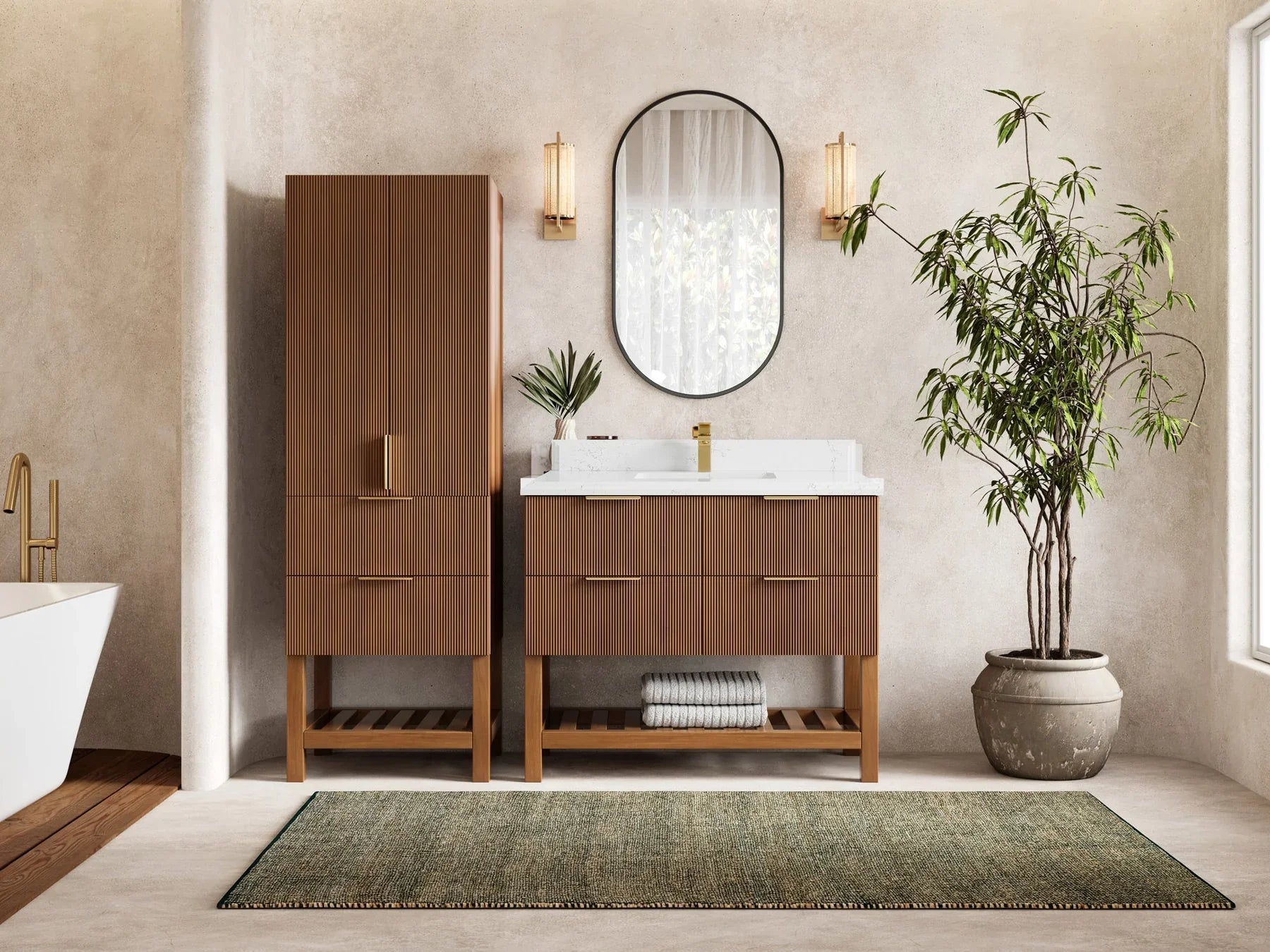
Teak is warm and golden-brown, deepening toward a richer honey tone as it ages — great for traditional, transitional, and coastal bathrooms. Its grain is fairly straight with occasional darker streaks and a naturally satiny surface. White oak is pale — blond to light tan — with a straight, open grain and characteristic long rays that give it a clean, contemporary character. It takes light and natural finishes beautifully, which is why it anchors so many modern and Scandinavian designs. Browse the teak collection and the white oak collection to compare tones side by side.
Hardness and durability
Both are hard, dense, and long-lasting, but they get there differently. White oak is one of the harder domestic hardwoods and is notably dent- and abrasion-resistant, so it stands up well to knocks and daily wear. Teak is slightly softer on paper but extraordinarily stable — it moves very little with changes in humidity, so it resists the cracking and warping that plague lesser materials in a steamy room. For a bathroom, both offer a lifetime of service when cared for.
Maintenance and cost
Teak needs the least maintenance because of its natural oils; a simple wipe-down keeps it looking good, and it tolerates the occasional missed water spot gracefully. White oak is very easy to live with too — keep its finish sealed and wipe up standing water promptly, and it will stay beautiful for decades. On price, teak is typically the premium option, as a slower-growing tropical hardwood, while white oak often offers a slightly more accessible price for comparable solid-wood quality. Crucially, either wood can be sanded and refinished years later to erase wear or change its tone — something a laminated board vanity simply cannot offer.
Which suits which style?
- Pick teak for maximum water resistance, warmth, and a timeless, coastal-to-traditional look.
- Pick white oak for a light, bright, modern or Scandinavian aesthetic.
- Want the best of both? Several collections are offered in teak and white oak, so you can match the wood to your room without changing the design you love.
Whichever you choose, pair it with a stone top — quartz or natural Carrara marble — for a surface that complements the wood and stands up to daily bathroom use.
FAQ
Is teak or white oak better for a bathroom vanity?
Teak is better for water resistance and low maintenance thanks to its natural oils, while white oak is better if you want a lighter, more modern look with excellent hardness. Both are durable solid-wood choices that far outperform MDF in a bathroom.
Is white oak good for a bathroom?
Yes. White oak’s dense, closed grain makes it naturally water-resistant, and with a sealed finish it holds up very well to bathroom humidity while offering a bright, contemporary look.
Does teak cost more than oak?
Usually yes. Teak is a slower-growing tropical hardwood and typically commands a premium, while white oak often offers similar solid-wood durability at a slightly lower price.
Can a teak or white oak vanity be refinished?
Yes. Because both are solid hardwood, they can be sanded and refinished years later to remove wear or update the tone. A laminated MDF or particleboard vanity cannot be refinished the same way, which is a key long-term advantage of solid wood.
Still deciding between warm teak and bright oak? Both are solid hardwood, refinishable, and topped with quartz or natural Carrara marble — you cannot go wrong.
Shop teak vanities · white oak vanities · all solid-wood vanities.
Share:
Bathroom Vanity Trends: Warm Wood, Fluted & Floating
Taj Mahal Quartzite Vanity Tops: Durability, Care & Cost