


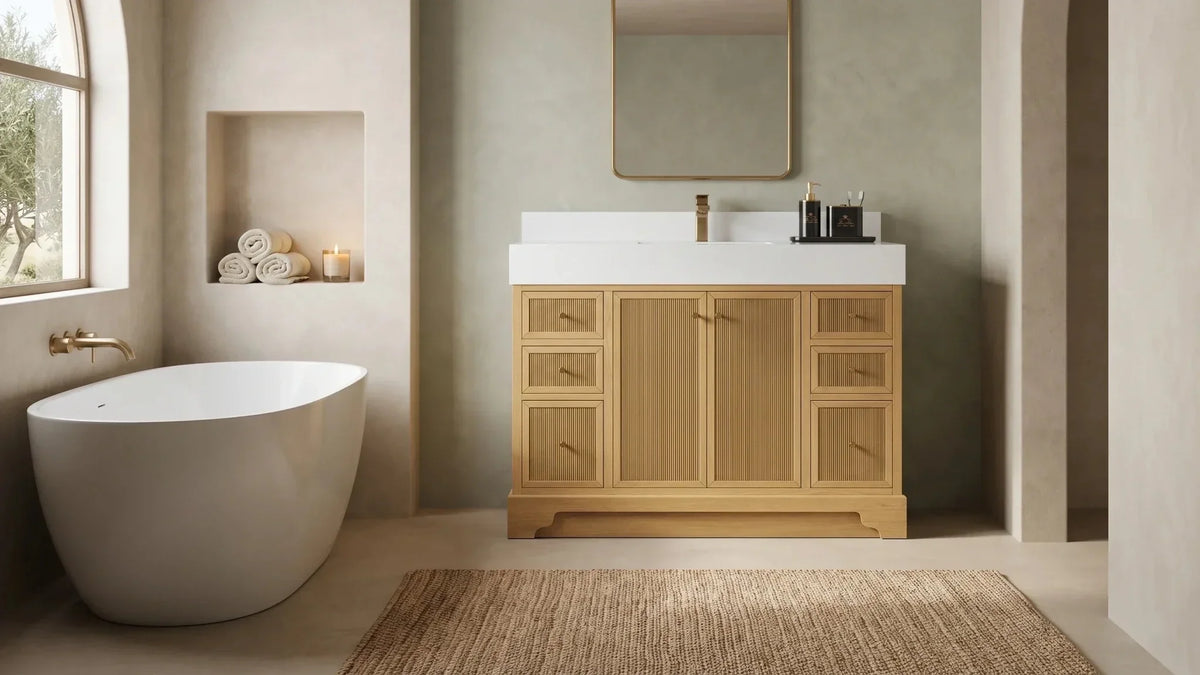
Are big-box bathroom vanities good quality? The honest answer is: some are, some are not. The name of the store matters less than the actual construction of the vanity. A bathroom vanity can look beautiful online, have a clean finish, and still fail early if the cabinet core is made from moisture-sensitive material in the wrong room.
The real question is not only “Is this vanity affordable?” or “Does it look good?” The better question is: What is the bathroom vanity made of? Is the cabinet built from MDF, particleboard, plywood, solid wood, or a combination of materials? Are the plumbing openings sealed? Are the drawers well built? Can the cabinet handle humidity, splashes, daily use, and cleaning?
This guide explains how to compare MDF bathroom vanities, particleboard bathroom vanities, plywood bathroom vanities, and solid wood bathroom vanities. It will also help you understand when a budget bathroom vanity makes sense, when a solid wood vanity is worth it, and how to judge quality before you buy.
Quick Answer: Are Big-Box Bathroom Vanities Good Quality?
Big-box bathroom vanities can be good quality, but quality varies widely from one model to another. A budget vanity may be perfectly fine for a powder room, rental, guest bath, or short-term remodel. But in a daily-use bathroom with steam, splashes, plumbing cutouts, and frequent cleaning, the core material matters much more.
At the lower end, many cheap bathroom vanities are made with MDF or particleboard cores under a painted, laminated, or veneered surface. These materials can look clean and smooth at first, but if water reaches the exposed core, especially around plumbing openings or unsealed edges, swelling and finish lifting can become permanent problems.
A more durable bathroom vanity usually uses solid wood structural parts and properly sealed plywood panels. This type of construction costs more upfront, but it is often a better long-term value in primary bathrooms, kids’ bathrooms, family bathrooms, and bathrooms near a shower or tub.
Best rule: Do not judge a bathroom vanity by the store category, photo, or price alone. Judge it by the cabinet core, drawer construction, finish quality, plumbing cutouts, hardware, and how the vanity will handle moisture.
What Actually Determines Bathroom Vanity Quality?
The quality of a bathroom vanity comes down to what is behind the finish. A smooth white cabinet, a marble-look top, or a nice product photo does not tell the full story. The inside materials and construction details are what decide whether the vanity will hold up in a wet room.
The most important quality factors are:
- Cabinet core material: MDF, particleboard, plywood, solid wood, or a combination.
- Back panel construction: especially around plumbing openings.
- Drawer boxes: dovetail or reinforced construction is stronger than thin stapled boxes.
- Hardware: soft-close hinges and slides are usually a better sign than low-cost hardware.
- Finish quality: sealed edges, smooth coating, and protected surfaces matter in humid rooms.
- Countertop fit: a properly fitted top helps protect the cabinet below.
- Assembly: fully assembled vanities are usually stronger than flat-pack cabinets.
- Repairability: solid wood and sealed plywood can often be maintained more easily than swollen fiberboard.
A bathroom vanity is not just furniture. It lives next to water lines, drains, sinks, faucets, wet hands, toothpaste, makeup, cleaning products, humidity, and sometimes steam from a nearby shower. That is why bathroom vanity material matters more than it would in a dry room.
MDF vs Particleboard vs Plywood vs Solid Wood
Most bathroom vanity quality questions come down to four material categories: MDF, particleboard, plywood, and solid wood. Each material can have a place, but they do not perform the same way in a humid bathroom.
MDF
MDF stands for medium-density fiberboard. It is made from wood fibers and resin pressed into a smooth panel. MDF paints well and creates a very smooth finish, which is why it is common in painted budget vanities. The risk is moisture. If water reaches an unsealed edge or cutout, MDF can swell and lose its original shape.
Particleboard
Particleboard is usually the lowest-cost cabinet core. It is made from wood chips or particles bonded together. It is affordable and can work in dry, light-use spaces, but it has the least margin for error in a bathroom. Once moisture reaches the core, it can swell, crumble, or lose strength.
Plywood
Plywood is made from thin layers of wood veneer bonded together. Because the grain direction alternates between layers, plywood is usually more stable than fiberboard or chipboard in many cabinet applications. Properly sealed plywood is a strong choice for vanity side panels, shelves, bottoms, and large flat surfaces.
Solid Wood
Solid wood is real lumber used for frames, legs, drawer fronts, rails, stiles, and other structural components. Solid wood gives a vanity a furniture-quality feel and can be maintained over time when properly finished and cared for. In a bathroom, it should still be sealed and protected from standing water.
Bathroom Vanity Material Comparison Chart
| Material | Best For | Pros | Watch Out For |
|---|---|---|---|
| MDF | Painted budget vanities, dry bathrooms, light-use spaces | Smooth painted finish, affordable, consistent surface | Can swell if moisture reaches exposed edges or plumbing cutouts |
| Particleboard | Lowest-cost vanities, short-term use, low-moisture rooms | Very affordable, lightweight, common in budget furniture | Most vulnerable to swelling, crumbling, and weak fastener holding |
| Plywood | Cabinet boxes, shelves, large panels, better vanity construction | Strong, stable, real wood-based layered construction | Still needs proper sealing around edges and plumbing openings |
| Solid wood | High-use bathrooms, primary baths, family baths, long-term remodels | Furniture-quality feel, durable, repairable, premium look | Costs more and still needs proper finish care |
| Solid wood + plywood | Best long-term bathroom vanity construction | Strong frame with stable large panels | Quality depends on finish, sealing, hardware, and construction details |
Best overall construction for daily-use bathrooms: solid wood structural components with properly sealed plywood panels. This gives the vanity strength, stability, and better long-term repairability than MDF or particleboard cores.
What Is an MDF Bathroom Vanity?
An MDF bathroom vanity is a vanity built partly or mostly with medium-density fiberboard. MDF can look very good when painted because it has a smooth, even surface. That is why many white, gray, black, blue, or green painted budget vanities use MDF doors or panels.
MDF is not automatically bad. It can work in lower-moisture bathrooms when the finish is well sealed and the vanity is not exposed to repeated splashing or steam. The problem is that standard MDF does not like water. If moisture gets into a raw edge, screw hole, plumbing opening, damaged corner, or lifted finish, the fibers can swell.
An MDF vanity may make sense if:
- You are updating a powder room with no shower or tub.
- The bathroom is lightly used.
- You need a short-term or budget-friendly solution.
- The edges, cutouts, and finish are well sealed.
- You understand that it may not be the longest-lasting choice for a wet bathroom.
An MDF vanity is riskier if:
- The bathroom has a shower or tub nearby.
- The vanity is used every day.
- Children use the bathroom and water splashes often.
- The cabinet has exposed cut edges around plumbing.
- The finish is already chipped, cracked, or lifting.
What Is a Particleboard Bathroom Vanity?
A particleboard bathroom vanity is typically a lower-cost vanity made with wood particles bonded into panels. Particleboard can be covered with laminate, veneer, or a painted surface to look clean from the outside, but the core is much more vulnerable when exposed to moisture.
Particleboard is often used because it keeps the sticker price low. That can make sense for temporary projects, rental refreshes, and rooms that do not see heavy moisture. But in a wet bathroom, particleboard is the material to inspect most carefully.
Common particleboard vanity issues include:
- Swelling around plumbing openings
- Puffy cabinet edges
- Finish lifting or bubbling
- Weak screw holding at hinges or drawer slides
- Cabinet bottoms softening after leaks
- Back panels crumbling around drain cutouts
If you are buying a very affordable vanity, read the product specifications carefully. If the cabinet box, shelves, bottom, or back panel are particleboard, use it only in a room where the moisture risk is low.
Is Plywood Good for Bathroom Vanities?
Yes. Plywood is a good material for bathroom vanities when it is properly sealed and used in the right construction. Plywood is not the same as MDF or particleboard. It is made from layers of wood veneer, which gives it better strength and dimensional stability than many fiberboard or chipboard cores.
Plywood is especially useful for large flat cabinet panels because it is more stable than solid wood across wide surfaces. That makes it a smart choice for vanity sides, bottoms, shelves, and back panels.
The key is sealing. Even plywood should be protected around edges, cuts, plumbing openings, and exposed surfaces. A well-made vanity may use solid wood for the frame and visible structural parts, with plywood panels where stability matters.
Plywood is a strong choice for:
- Vanity side panels
- Cabinet bottoms
- Shelves
- Back panels
- Large flat surfaces
- Bathrooms where stability matters
Why Choose a Solid Wood Bathroom Vanity?
A solid wood bathroom vanity is usually the better choice for a bathroom that gets daily use. Solid wood gives the cabinet a stronger, more furniture-quality feel. It is also more repairable and maintainable than a swollen MDF or particleboard cabinet.

Solid wood does not mean the vanity should be ignored after installation. Wood still needs a good finish, proper ventilation, and protection from standing water. But when properly built and maintained, a solid wood vanity can handle the life of a bathroom better than a budget fiberboard cabinet.
Choose a solid wood bathroom vanity if:
- This is your primary bathroom.
- The vanity is used every day.
- The bathroom has a shower or tub.
- You want a longer-term remodel, not a short-term fix.
- You care about drawer feel, cabinet weight, and repairability.
- You want a premium wood finish such as teak, white oak, or mango wood.
Popular solid wood looks include teak bathroom vanities, white oak bathroom vanities, and mango wood bathroom vanities.
Is Veneer Bad on a Bathroom Vanity?
No. Veneer is not automatically bad. In fact, many high-quality cabinets use real wood veneer over plywood panels because wide solid wood panels can move more with humidity. The real question is not “Does this vanity have veneer?” The better question is: What is under the veneer?
There is a big difference between:
- Real wood veneer over plywood
- Real wood veneer over MDF
- Laminate over particleboard
- Paint over MDF
- Solid wood frame with plywood panels
A veneer over plywood can be part of a durable, furniture-grade vanity. A thin surface over MDF or particleboard can still look good at first, but it becomes more vulnerable if moisture reaches the core.
| Spec Sheet Wording | What It May Mean | What to Ask |
|---|---|---|
| Wood | Could mean many things | Is it solid wood, plywood, MDF, particleboard, or veneer? |
| Engineered wood | May include MDF, particleboard, plywood, or other panels | Which engineered wood is used in the cabinet box? |
| Wood veneer | A thin layer of real wood over another core | Is the core plywood, MDF, or particleboard? |
| All-wood construction | Can be used differently by different sellers | What are the sides, bottom, back, shelves, and drawers made from? |
| Solid wood frame | Often a better construction detail | Are large panels plywood or MDF? |
Where Cheap Bathroom Vanities Usually Fail First
Cheap bathroom vanities often fail in predictable places. The outside may look fine at first, but moisture usually finds weak spots around cuts, openings, corners, seams, and hardware.
Watch these areas:
- Plumbing openings: holes in the back panel for drain and water lines.
- Cabinet bottom: especially after leaks or repeated wet cleaning.
- Edges near the sink: where water sits or drips.
- Door corners: where finish can chip and expose the core.
- Drawer fronts: especially near wet hands and daily splashes.
- Hinge screws: weak cores may loosen over time.
- Toe kick or base: vulnerable during mopping or bathroom leaks.
The most important weak point is often the plumbing opening. Even if the countertop sink cutout is factory-made, the cabinet back panel may still need openings for the drain and supply lines. If those cut edges expose MDF or particleboard, moisture can enter from a hidden spot.
When a Budget Bathroom Vanity Makes Sense
A budget bathroom vanity is not always a bad idea. It can be the right choice when the room is low-moisture, lightly used, or not intended as a long-term investment.
A cheaper bathroom vanity can make sense for:
- Powder rooms with no shower or tub
- Guest bathrooms used occasionally
- Rental properties where budget matters most
- Short-term remodels before a full renovation
- Home staging or cosmetic updates
- Low-splash bathrooms with good ventilation
In these situations, an MDF or particleboard vanity can still look good and function well if the finish is sealed, the plumbing openings are protected, and the room stays mostly dry.
Best use for a budget vanity: a dry powder room, a light-use guest bathroom, or a short-term update where the vanity will not face daily steam, splashes, and heavy cleaning.
When Solid Wood Is Worth the Extra Cost
A solid wood bathroom vanity is usually worth the extra cost when the bathroom is used every day. In a wet, high-use bathroom, the real cost is not only the purchase price. You also have to consider installation, removal, replacement, plumbing disruption, and the time it takes to redo the same project later.
Solid wood and plywood construction is worth it for:
- Primary bathrooms
- Shared bathrooms
- Kids’ bathrooms
- Bathrooms near a shower or tub
- Luxury bathroom remodels
- Long-term homes
- Large double sink vanities
- Bathrooms where drawer quality and storage matter
For high-use spaces, shop stronger vanity layouts such as freestanding single sink vanities, freestanding double sink vanities, floating single sink vanities, and floating double sink vanities.
Bathroom Vanity Quality Checklist
Use this checklist before buying any bathroom vanity, whether it is budget, mid-range, or premium.
Bathroom Vanity Quality Checklist:
- Cabinet box material: solid wood / plywood / MDF / particleboard
- Frame material confirmed: yes / no
- Side panel material confirmed: yes / no
- Bottom panel material confirmed: yes / no
- Back panel material confirmed: yes / no
- Shelf material confirmed: yes / no
- Drawer box material confirmed: yes / no
- Dovetail drawer construction: yes / no
- Soft-close drawers: yes / no
- Soft-close doors: yes / no
- Plumbing openings sealed or sealable: yes / no
- Edges protected from moisture: yes / no
- Countertop included: yes / no
- Sink included: yes / no
- Faucet drilling confirmed: single-hole / 4 inch centerset / 8 inch widespread / wall mount
- Ships fully assembled: yes / no
- Warranty reviewed: yes / no
- Return policy reviewed: yes / no
- Room type: powder room / guest bath / primary bath / kids’ bath / rental
Questions to Ask Before Buying
Before buying a bathroom vanity, ask questions that reveal the actual construction. Marketing language can be vague, so the goal is to identify the material behind the surface.
| Question | Why It Matters |
|---|---|
| What is the cabinet box made of? | The box carries the vanity and handles moisture around plumbing. |
| Are the side panels plywood, MDF, particleboard, or solid wood? | Side panels affect strength and long-term stability. |
| What is the back panel made of? | The back panel is cut for plumbing and is a common moisture risk area. |
| Are the plumbing openings sealed? | Raw cutouts can expose vulnerable core material. |
| Are the drawers dovetailed or stapled? | Dovetail joinery usually signals stronger drawer construction. |
| Are the hinges and slides soft-close? | Better hardware helps the vanity feel and perform better over time. |
| Does it ship assembled or flat-packed? | Fully assembled cabinets often feel stronger and more furniture-like. |
| Is this vanity recommended for high-moisture bathrooms? | A primary bath or kids’ bath needs a more durable build than a powder room. |
How Willow Builds Bathroom Vanities
At Willow Bath & Vanity, the focus is on bathroom vanities built for real bathroom use. Our vanities are made with solid wood components and plywood panels where large surfaces need added stability. We do not use MDF or particleboard as the main cabinet core.

That difference matters because bathrooms are humid rooms. A vanity should handle daily routines, splashes, cleaning, plumbing access, drawers opening and closing, and long-term use. The goal is not only to make the vanity look beautiful on delivery day. The goal is to make it feel substantial and stay beautiful in the room.
Explore durable vanity options by material and finish:
- Teak bathroom vanities
- White oak bathroom vanities
- Mango wood bathroom vanities
- Fluted and reeded bathroom vanities
- Modern bathroom vanities
- Best-selling bathroom vanities
See Vanity Quality in Person
Bathroom vanity quality is much easier to judge in person. Photos can show color and style, but they do not always show cabinet weight, drawer construction, finish texture, countertop thickness, plumbing openings, or how the vanity feels when you open and close it.
At a Willow Bath & Vanity showroom, you can compare solid wood vanities, plywood panels, drawer construction, finishes, countertops, sink layouts, hardware, single sink vanities, double sink vanities, floating vanities, and freestanding vanities in person.
Bring your bathroom measurements, photos of your current space, plumbing location, preferred vanity width, sink layout, faucet style, and countertop preference. This makes it easier to choose a vanity that fits the room and performs well over time.
Final Thoughts
So, are big-box bathroom vanities good quality? They can be, but you need to inspect the construction. A low-cost vanity may be the right choice for a dry powder room, a guest bath, or a short-term update. But for a bathroom used every day, especially one near a shower or tub, the cabinet core matters more than the photo, finish, or price.
If the vanity is made from MDF or particleboard, look closely at the edges, plumbing openings, bottom panel, drawer construction, and moisture protection. If you want a longer-lasting bathroom vanity, look for solid wood structural components, properly sealed plywood panels, dovetail drawers, soft-close hardware, and a finish designed for bathroom use.
The best bathroom vanity is not always the cheapest or the most expensive. It is the one built for the room where it will live. For dry, light-use rooms, a budget vanity may be enough. For primary bathrooms, shared bathrooms, kids’ bathrooms, and long-term remodels, a solid wood and plywood vanity is usually the smarter investment.
Need help choosing the right size before you buy? Read our bathroom vanity measurement guide or browse vanities by size: 20"–29", 30"–39", 40"–49", 50"–69", 70"–79", and 80" & up.
FAQ: Bathroom Vanity Quality
Are big-box bathroom vanities good quality?
Some big-box bathroom vanities are good quality, but quality varies widely. The most important factor is not where the vanity is sold, but what it is made of. Check whether the cabinet core is MDF, particleboard, plywood, solid wood, or a combination of materials.
Are cheap bathroom vanities worth it?
Cheap bathroom vanities can be worth it for powder rooms, guest bathrooms, rentals, or short-term updates. They are less ideal for primary bathrooms, kids’ bathrooms, shared bathrooms, or any bathroom with heavy moisture and daily use.
What are cheap bathroom vanities usually made of?
Many cheap bathroom vanities are made with MDF or particleboard cores under a painted, laminated, or veneered surface. These materials can look good at first, but they are more vulnerable if water reaches exposed edges, corners, or plumbing openings.
Is MDF good for a bathroom vanity?
MDF can work in a low-moisture bathroom if it is properly sealed and not exposed to repeated splashing. It is not the best choice for high-moisture bathrooms, daily-use primary baths, or bathrooms where water often reaches the cabinet.
Is particleboard bad for bathroom vanities?
Particleboard is the most budget-friendly cabinet core and is also one of the most vulnerable to moisture. It can be acceptable in dry, light-use rooms, but it is not ideal for bathrooms with showers, tubs, leaks, or frequent splashing.
Is plywood good for bathroom vanities?
Yes. Properly sealed plywood is a strong material for bathroom vanity boxes, shelves, backs, bottoms, and large flat panels. It is different from MDF and particleboard because it is made from layers of wood veneer bonded together.
Is solid wood good for bathroom vanities?
Yes. Solid wood is a strong choice for bathroom vanities when it is properly finished and maintained. It gives the vanity a furniture-quality feel and is usually more repairable than MDF or particleboard if surface wear occurs.
What is the best material for a bathroom vanity?
For daily-use bathrooms, the best construction is usually solid wood structural components with properly sealed plywood panels. This combination gives the vanity strength, stability, and better moisture performance than MDF or particleboard cores.
Is veneer bad on a bathroom vanity?
Veneer is not automatically bad. The important question is what is underneath the veneer. Veneer over plywood can be part of a high-quality vanity, while veneer over MDF or particleboard is more vulnerable if moisture reaches the core.
Where do bathroom vanities fail first?
Bathroom vanities often fail first around plumbing openings, cabinet bottoms, unsealed edges, sink areas, drawer fronts, door corners, and hinge screws. These are the areas most likely to see water, humidity, or stress.
How can I tell if a bathroom vanity is good quality?
Check the cabinet box material, back panel, drawer construction, hardware, soft-close features, plumbing cutouts, edge sealing, finish quality, countertop fit, and whether the vanity ships assembled. A good vanity should clearly state what it is made of.
Is a solid wood vanity worth the extra cost?
A solid wood vanity is usually worth the extra cost in a primary bathroom, shared bathroom, kids’ bathroom, or any bathroom used daily. It costs more upfront, but it is often a better long-term value because it is stronger, more repairable, and better suited to wet rooms.
What type of vanity is best for a powder room?
A powder room has lower moisture because it usually does not have a shower or tub. This means a budget vanity can work, but a solid wood vanity will still feel more substantial and offer a higher-end look.
What type of vanity is best for a primary bathroom?
For a primary bathroom, choose a solid wood or solid wood and plywood vanity with soft-close drawers, sealed surfaces, strong hardware, and a durable countertop. Primary bathrooms need better construction because they are used every day.
Where can I see bathroom vanity quality in person?
You can visit a Willow Bath & Vanity showroom to compare solid wood vanities, plywood panels, drawer construction, countertops, sink layouts, finishes, and hardware in person.

Share:
How to Measure for a Bathroom Vanity: Width, Depth, Height, Plumbing & Clearance Guide
Standard Bathroom Vanity Dimensions