


Choose a floating (wall-mounted) vanity to free up floor space, make a small bathroom look bigger, and set a custom counter height that fits you; it must be anchored into solid wall studs or blocking, so plan the install. Choose a freestanding vanity for maximum storage, a straightforward install, and no wall-strength worry at all. Both are excellent when the cabinet is built from real wood — solid lumber and plywood — rather than an MDF or particleboard core that can swell where water reaches an exposed edge. Below is the honest, side-by-side breakdown so you can pick with confidence.
Quick verdict: floating vs freestanding at a glance
There's no single "better" vanity, only the better match for your bathroom, your wall, and how much you store. Here's the fast comparison before we go deeper.
| Floating (wall-mounted) | Freestanding | |
|---|---|---|
| Best for | Small or modern baths, custom height, open sightlines | Storage, easy install, traditional or transitional looks |
| Floor space | Exposes floor underneath, feels roomier | Occupies the floor footprint fully |
| Storage | Slightly less; no floor-level toe space | Usually more; deeper base and full-height cabinet |
| Install | Must hit studs or blocking; pro strongly advised | Set on the floor, level, connect plumbing |
| Wall strength | Critical — the wall carries the load | Not a factor — the floor carries the load |
| Height | Mount at any height you choose | Fixed by the cabinet's build |
| Cleaning | Mop straight under it | Base meets the floor |
The Willow Bath and Vanity angle, said plainly
Willow Bath and Vanity builds both styles with solid wood components and veneered plywood panels where large surfaces need added stability — no MDF or particleboard core. That construction matters most on a floating vanity: a real-wood cabinet is heavier than a big-box particleboard unit, so it genuinely has to land on studs or proper blocking. The upside is that solid wood and properly sealed plywood can be protected and maintained at a cut edge, while MDF and particleboard are the materials most likely to swell once moisture reaches an exposed core — often around the plumbing openings, where the drain and water lines pass through the back panel. So we'll answer honestly and help you either way.
Storage: do floating vanities hold enough?
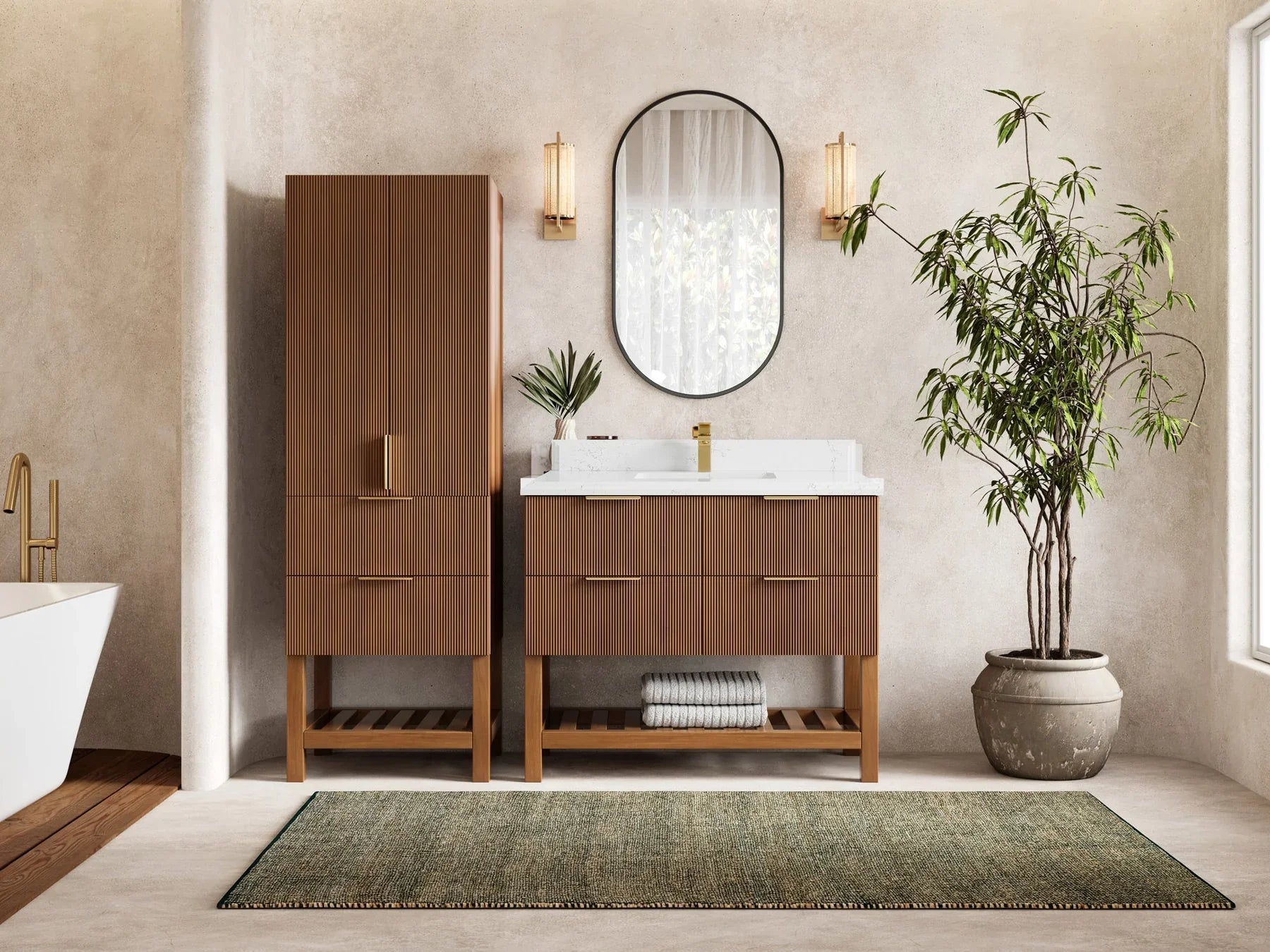
For most bathrooms, yes. A floating vanity holds plenty for daily use — towels, bottles, a hair dryer, and the usual under-sink kit. The honest trade-off is that a wall-mounted cabinet typically offers a little less storage than a same-width freestanding one, because it stops short of the floor and can't use that lowest few inches, and manufacturers of particleboard units often keep the box shallower to keep weight down for the wall.
Freestanding vanities win on raw capacity. Sitting fully on the floor, they can carry a deeper, taller cabinet with more drawer volume and full-height doors — ideal if your bathroom is the household's main storage for linens and supplies. If you're outfitting a primary bath and want the most room to stash things, a freestanding double-sink vanity gives two people their own drawer stacks plus generous shared space below.
One thing that doesn't change with either mount: the quality of the box. A drawer is only as good as its joinery and its core. The honest question is not whether a panel carries any veneer — almost every maker veneers wide surfaces — it is what sits under that veneer. Willow Bath and Vanity uses solid wood with dovetailed drawers and soft-close hardware, so the storage you buy stays square and smooth-running for years — not a drawer built over a particleboard core that loosens the first humid summer.
Install and wall strength: the weight question
This is where floating and freestanding truly diverge, and it's the part people underestimate.
How much weight can a floating vanity hold?
A properly installed floating vanity anchored into wood studs (or concrete) can support roughly 200 to 400 pounds, which is far more than the cabinet, countertop, sink, and its contents will ever weigh in normal use. The number that matters isn't the cabinet's rating — it's what's behind your drywall.
Why blocking and studs are non-negotiable
A floating vanity should never be hung on drywall alone. For a secure install it has to anchor into wall studs or into solid blocking — a horizontal piece of lumber added between the studs inside the wall cavity so you have a solid surface to bolt into across the full width of the vanity, not just where the studs happen to fall. Pros typically mount into at least two studs with lag bolts or a French cleat, and for wider or double-sink units, blocking isn't optional.
Here's the Willow Bath and Vanity-specific truth: because our cabinets are built from real wood — solid lumber and plywood, not particleboard — they carry real furniture weight. That's a feature — it's the same real-wood construction that holds a screw and resists water at a cut edge — but it means you should treat the wall attachment seriously. If your existing framing doesn't line up with the vanity's mounting points, a contractor opens the wall, adds blocking, and patches it. That's a normal step, not a red flag. We'd rather tell you plainly than pretend a heavy, well-built cabinet will hang on hollow drywall.
Freestanding install: simpler, no wall worry
A freestanding vanity sidesteps all of that. You set it on the floor, level it, secure it lightly to the wall to prevent tipping, and connect the plumbing. There's no stud-hunting, no blocking, no wall-strength calculation — the floor carries everything. If you're renovating on a schedule, replacing an old vanity in the same spot, or you simply don't want to open a wall, freestanding is the lower-friction choice. Browse freestanding single-sink vanities for a straightforward one-for-one swap.
Small bathrooms: which one wins?
For a small or busy bathroom, floating usually has the edge — for reasons of sightline, not storage. By lifting the cabinet off the floor, a wall-mounted vanity exposes the flooring underneath, and that visible stretch of floor tricks the eye into reading more square footage than the room actually has. The room breathes. It also makes cleaning trivial: a mop or robot vacuum passes straight underneath, with no base trim collecting dust and no gap where water can sit against the cabinet.
Custom height is an underrated floating advantage
Because you decide where the cleat lands, a floating vanity can be mounted at whatever height suits the household. Standard vanities land around 32 to 36 inches to the countertop, with "comfort height" near 36 inches now common. With a floating unit you can go taller for tall adults, or lower in a kids' or powder bath — a freestanding cabinet fixes that height for you. Shop compact wall-mounted options in floating single-sink vanities, and if the small room is actually a shared primary bath, a floating double-sink vanity keeps the floor open while serving two.
The one caveat for small baths: don't let the "small room" framing tempt you toward a flimsy cabinet. A tight, high-traffic bathroom is exactly where an MDF or particleboard core tends to fail first, because splashes and steam have nowhere to go and any exposed edge stays damp. Real wood — solid lumber and sealed plywood — is the durable choice precisely in the rooms that get the hardest use.
So, which should you buy?
Lean floating if your bathroom is small or modern, you want the floor to read as open, you'd like a custom counter height, and you're comfortable anchoring into studs or adding blocking (or hiring it out). Lean freestanding if you want maximum storage, the simplest possible install, no wall-strength question, or a classic furniture-style look that sits on the floor.
Whichever mount you pick, the cabinet itself is the decision that outlives the trend. Willow Bath and Vanity's cabinet ships fully assembled and pre-finished — no flat-pack — while the countertop ships separately in its own protective box and the undermount sink is set during installation. Explore both mounts and match the size and sink layout to your room:
- Floating single-sink vanities — open up a compact or guest bath.
- Floating double-sink vanities — keep the floor clear in a shared primary.
- Freestanding single-sink vanities — the easy, no-wall-worry swap.
- Freestanding double-sink vanities — maximum storage for two.
Answer the wall-and-storage question first, then choose the wood and finish you'll love looking at every morning. Both paths lead to the same place: a real-wood vanity — solid lumber and plywood, never MDF or particleboard — built to survive the one room in the house that's wet on purpose.
Frequently Asked Questions
Do floating vanities hold enough weight?
Yes. A floating vanity anchored into wall studs or solid blocking can support roughly 200 to 400 pounds, well beyond the weight of the cabinet, countertop, sink, and its contents in normal use. The limit isn't the cabinet's rating but the wall behind it, which is why anchoring into studs or added blocking matters. A real-wood cabinet built from solid lumber and plywood is heavier than a particleboard one, so proper wall attachment is essential.
Can you install a floating vanity on drywall alone?
No. A floating vanity must anchor into wall studs or into blocking, a horizontal length of lumber added between the studs inside the wall cavity. Drywall alone cannot safely carry the load. Installers typically bolt into at least two studs or use a French cleat, and for wider or double-sink units, blocking is required rather than optional.
Which is better for a small bathroom, floating or freestanding?
Floating usually wins for a small bathroom because lifting the cabinet off the floor exposes the flooring underneath and makes the room feel larger. It also lets a mop or robot vacuum pass straight underneath, which keeps cleaning easy and stops water from sitting against the base. Freestanding still makes sense in a small bath if storage is your priority, since it uses the full floor footprint for a deeper cabinet.
Do freestanding vanities hold more than floating vanities?
Usually, yes. Because a freestanding vanity sits fully on the floor, it can carry a deeper, taller cabinet with more drawer volume and full-height doors, while a floating vanity stops short of the floor and gives up that lowest few inches. The gap is modest for everyday use, so a floating vanity still holds plenty for towels, bottles, and the usual under-sink items. What matters more than mount is the box itself: a cabinet built from solid wood and plywood, with dovetailed, soft-close drawers, stays square and smooth-running far longer than one built over an MDF or particleboard core.
Share:
How to Measure for a Bathroom Vanity: Width, Depth, Height, Plumbing & Clearance Guide
Standard Bathroom Vanity Dimensions