


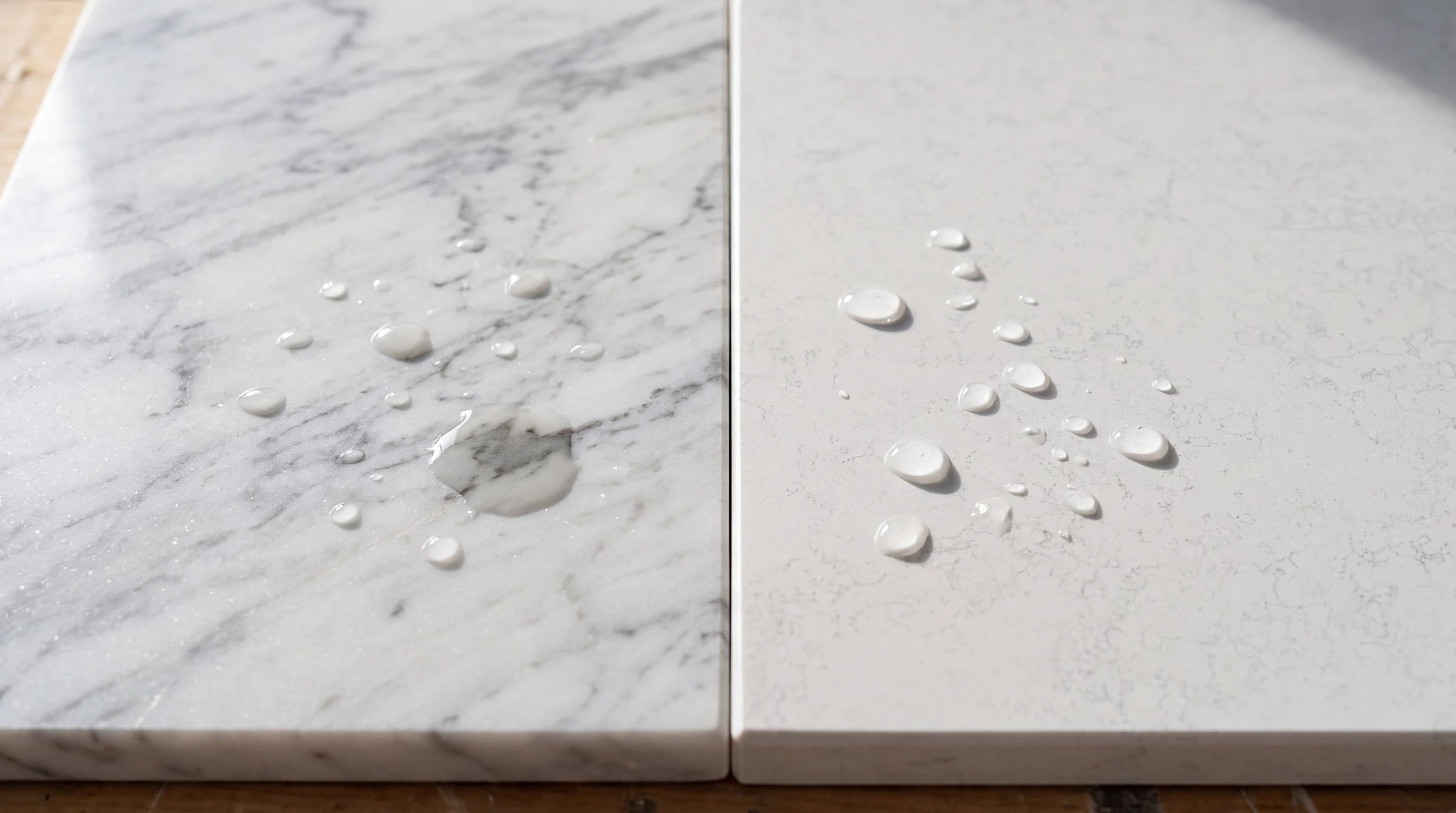
Quick answer: choose engineered quartz when you want a non-porous, consistent, lower-maintenance vanity top. Choose natural marble when one-of-a-kind veining matters more than the extra care required for a porous, acid-sensitive stone. Neither material is damage-proof, and the exact top, finish, edge, basin, and backsplash depend on the selected vanity variant.
This guide keeps the decision focused on quartz vs marble bathroom vanity tops. Quartzite is a different natural stone, not another name for quartz. If your question is about natural Taj Mahal quartzite versus Taj Printed Quartz, read the separate quartzite vs engineered quartz guide.
Quartz vs Marble at a Glance
| Decision factor | Engineered quartz | Natural marble |
|---|---|---|
| Material | Engineered surface made with mineral content, pigments, and resin | Natural stone cut from a quarried slab |
| Pattern | More repeatable and controlled, although layout still varies by fabrication | Unique veining and natural variation |
| Porosity | Non-porous | Porous |
| Sealing | Generally not required | Often recommended; follow stone-specific instructions |
| Acid etching | Not the same calcium-carbonate etching risk as marble, but harsh chemicals can damage resin or finish | Can etch from acidic products |
| Heat | Resin can discolor or scorch; use a heat mat | Natural stone tolerates heat better, but a heat mat is still the safe choice |
| Best for | Busy shared baths, rentals, and buyers who want predictable care | Buyers who value natural variation and accept patina and maintenance |
What Is an Engineered Quartz Vanity Top?
A quartz countertop is an engineered surface. Manufacturers combine quartz-rich mineral material with resin, pigments, and other components, then form and finish the slab. The exact formulation varies by manufacturer, so a universal stone-to-resin percentage should not be applied to every product.
The practical bathroom advantage is low porosity. Everyday water and many common toiletries stay on the surface rather than soaking into it, and the top generally does not need sealing. Quartz patterns can be quiet and nearly solid, or they can reproduce Carrara- and Calacatta-inspired movement. Compare Willow's current range in the quartz countertop color guide.
Engineered quartz is durable, but it is not indestructible. Abrasive cleaners can dull the finish, sharp impact can chip an exposed edge, and direct heat can damage the resin. Use a soft cloth, a mild cleaner approved for quartz, and a heat-resistant mat under curling irons and straighteners.
What Is a Natural Marble Vanity Top?
Marble is a natural stone with mineral veining created through geological processes. That natural variation is its main appeal: two tops cut from different parts of a slab will not be visually identical. Carrara marble commonly presents a light field with gray movement, but the exact tone, veining, and surface character vary.
Marble is porous and contains calcium carbonate, so it can stain and etch. An etch is a dull mark created when an acidic product reacts with the stone; it is different from a stain absorbed into the material. Bathroom products such as acidic cleaners and some cosmetics can cause damage if they sit on the surface. Prompt cleanup and the correct stone-safe cleaner matter.
Sealing can reduce absorption, but it does not make marble stain-proof or etch-proof. The correct sealer and resealing interval depend on the stone, finish, fabricator, and use. Follow the instructions supplied with the actual top.
Appearance: Consistency or One-of-a-Kind Veining?
Quartz is the more predictable choice. A sample can show the color family and pattern direction, which helps when coordinating several vanities or planning around tile and paint. Large-scale printed or veined patterns still change across a fabricated top, so the sample is a guide rather than a guaranteed miniature of the final layout.
Marble is the more individual choice. Natural veining, small mineral marks, and tonal variation are part of the material rather than manufacturing defects. Buyers who want a perfectly uniform surface usually prefer quartz. Buyers who want depth and natural variation often prefer marble.
Before deciding, compare a countertop sample beside the cabinet finish, floor tile, wall color, and hardware under the bathroom's actual lighting. Willow offers finish and countertop samples, and materials can also be viewed at the Norcross and Alpharetta showrooms.
Water, Toiletries, Stains, and Hygiene
Quartz is non-porous, so routine splashes and many common bathroom products are easier to manage. Wipe spills promptly and avoid solvent-based or highly alkaline cleaners unless the countertop manufacturer specifically approves them.
Marble needs quicker cleanup because liquids can enter the surface and acidic products can etch it. Makeup, hair dye, perfume, mouthwash, and cleaning products should not be left standing. A tray under frequently used products can reduce rings and spills, but the tray itself should be lifted and cleaned regularly so moisture does not stay trapped.
Both materials can be hygienic when cleaned correctly. A non-porous surface simplifies the routine, but hygiene still depends on normal cleaning, dry seams, intact caulk, and prompt repair of chips or failed sealant around the basin and backsplash.
Scratches, Chips, and Edge Damage
Quartz generally handles everyday bathroom use well, but exposed corners and sink cutouts can chip under a hard impact. Do not use the vanity top as a workbench during installation, and avoid dropping heavy bottles or tools near the edge.
Marble is softer and can scratch more readily. A honed finish may make light wear less visually obvious than a polished finish, while polished marble shows etching as a contrast in sheen. Some natural-stone wear can be professionally refinished, but prevention is less disruptive than repair.
For either material, the edge profile affects both appearance and vulnerability. Confirm the exact edge offered on the selected vanity rather than assuming every color and size uses the same profile.
Heat and Styling Tools
A bathroom countertop does not face cookware, but hair tools create concentrated heat. Engineered quartz contains resin, so a hot iron placed directly on the surface can discolor or damage it. Natural marble handles heat differently, but direct heat can still stress the finish, sealer, or surrounding caulk.
Use a silicone or manufacturer-approved heat mat on both materials. Keep the tool away from the backsplash joint, basin rim, and electrical cord path, and unplug it after use.
Cleaning and Maintenance
Quartz care
- Wipe water and toiletries with a soft cloth.
- Use mild soap or a cleaner approved for engineered quartz.
- Avoid abrasive powders, scouring pads, paint removers, and unapproved solvents.
- Use a heat mat under styling tools.
- Inspect caulk around the basin and backsplash so water does not reach the cabinet below.
Marble care
- Blot spills promptly instead of spreading them across the surface.
- Use a pH-neutral natural-stone cleaner.
- Avoid vinegar, lemon, acidic bathroom cleaners, and abrasive pads.
- Follow the fabricator's sealing guidance and use a water-drop test only if it is appropriate for the finish.
- Expect natural patina, or choose quartz if visible etching will be unacceptable.
Cost and Availability
Installed cost cannot be reduced to one reliable national price range. It changes with slab or color, vanity width, sink count, edge fabrication, backsplash, faucet drilling, shipping, labor, and local market conditions. Natural marble also varies by grade and slab selection, while engineered quartz pricing varies by pattern and manufacturer.
For a Willow order, compare the actual price and included components on the selected product variant. Do not assume that every vanity includes the same top, basin, backsplash, edge, or faucet-hole configuration.
Which One Should You Choose?
- Choose quartz when low maintenance, pattern consistency, and no routine sealing are the priorities.
- Choose marble when natural variation and classic stone character outweigh the risk of etching and the need for stone-specific care.
- Choose neither until you confirm the variant when the exact countertop, basin, edge, or backsplash is unclear. The product page and cart selection should identify what is included.
Browse the broad bathroom vanity countertop guide or review all bathroom vanities. Then verify the cabinet construction, countertop, basin, edge and backsplash on the exact product page and selected cart line item.
Frequently Asked Questions
Is quartz or marble better for a bathroom vanity?
Quartz is usually better for low-maintenance bathrooms because engineered quartz is non-porous and generally does not need sealing. Marble is better for buyers who prioritize unique natural veining and accept more care, including the risk of etching and staining.
Does a quartz vanity top need sealing?
Engineered quartz generally does not need sealing. Clean it with a soft cloth, mild soap, and water, and follow the care instructions supplied with the selected top.
Does a marble vanity top need sealing?
Many natural marble tops benefit from sealing, but the interval depends on the stone, finish, sealer, and use. Follow the fabricator or manufacturer instructions and test the surface rather than relying on a universal schedule.
Can a hot hair tool damage quartz or marble?
Direct heat can damage the resin in engineered quartz and can also create thermal stress or finish damage on natural stone. Use a heat-resistant mat under styling tools on either surface.
Is quartz the same as quartzite?
No. Quartz countertops are engineered surfaces made with mineral content and resin. Quartzite is a natural stone. If you are comparing natural Taj Mahal quartzite with Taj Printed Quartz, use the separate quartzite-versus-quartz guide. Read the natural Taj Mahal quartzite vs Taj Printed Quartz comparison.
Can I choose the same quartz or marble top on every Willow vanity?
Not necessarily. Countertop material, color, edge, backsplash, basin, and faucet-hole options vary by model, size, and variant. The selected product page and cart are the source of truth.
Share:
Why Teak Works in Bathrooms: Moisture, Grain, Care & Buying Checks
Blue Bathroom Vanity Ideas: 6 Looks for Tile, Tops & Hardware